
Software Development Outsourcing: The Hidden Cost of Junior Talent
Classic IT outsourcing fails through a 'bait and switch' staffing model. Here is what it actually costs, how senior-only delivery changes the math, and how to evaluate any outsourcing partner before signing.
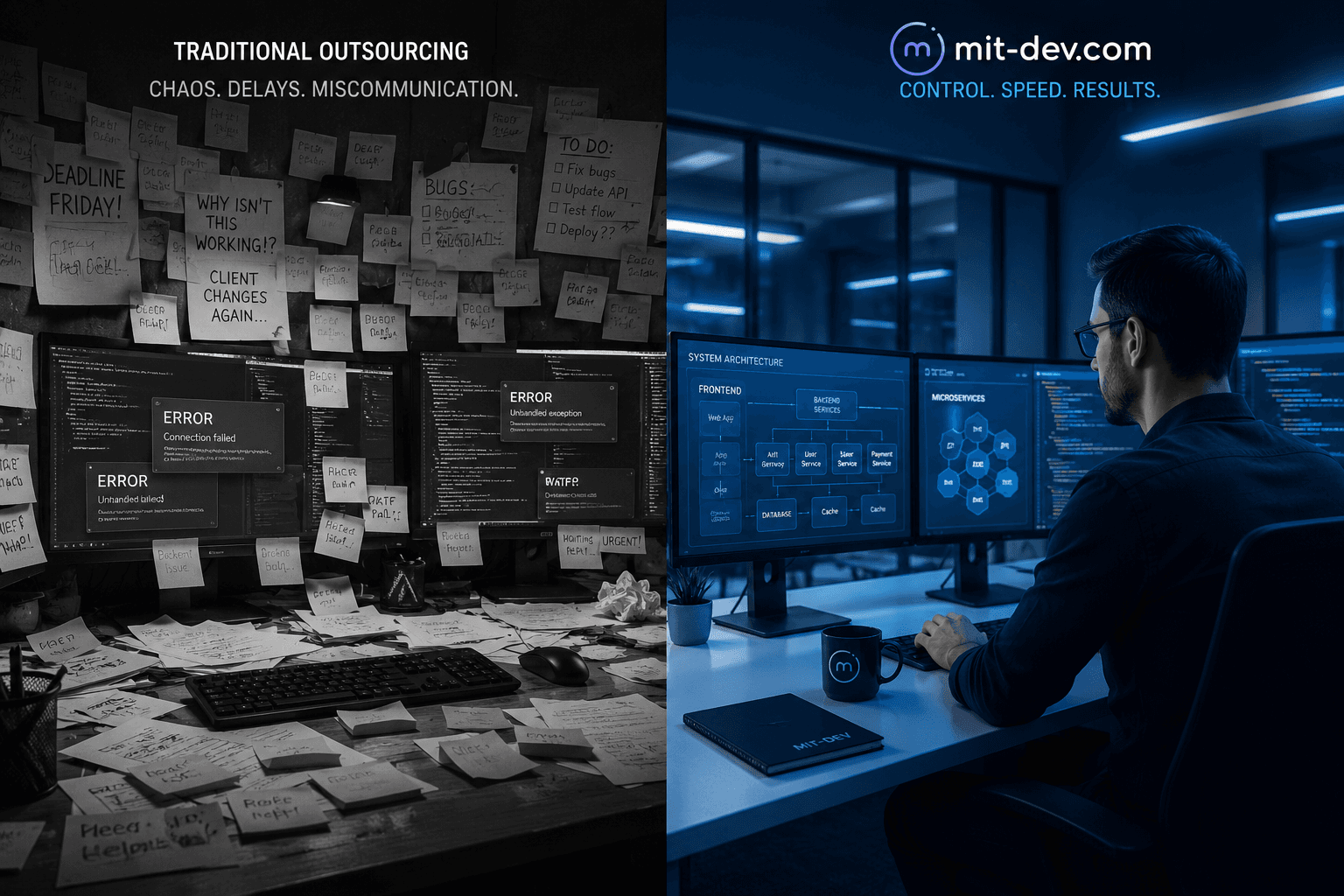
Software development outsourcing fails most often not because of timezone, language, or culture - it fails because of the "bait and switch": the senior architects you meet during sales rarely write the code that ends up in your codebase. This article breaks down what that staffing model actually costs in technical debt and missed deadlines, how an all-senior delivery model changes the math, and how to evaluate any outsourcing partner before signing. Includes a side-by-side comparison table, a four-phase delivery framework, and answers to the five questions CTOs ask most about senior-only outsourcing.
The Bait-and-Switch Model: Why Classic Outsourcing Fails
In the software outsourcing industry, the classic business model is "bait and switch": you meet senior architects during the sales process, sign the contract, and then watch the project get handed off to a team of juniors. The pattern is well documented across consultancy economics - agencies maximise margin by billing senior rates while staffing junior labour. As a software architect, I have seen the consequences of this model countless times across audits of failed engagements:
- Redundant code that grows the codebase faster than the feature set
- Technical debt that accumulates faster than it can be paid down
- Constantly missed deadlines because juniors hit architectural problems they cannot unblock themselves
- Repeated rewrites by the next vendor when the first project becomes unmaintainable
The Standish Group's CHAOS Report has consistently placed software-project failure rates in the same range for two decades: roughly 31% outright failed and another ~50% "challenged" - over budget, late, or under-scope. The pattern is not random. It tracks team seniority and decision quality, not headcount.
Why Seniors Are the Only Profitable Option
The economics of software development are inverse to most labour markets. A senior engineer is not 2x more productive than a junior - measured by shipped, maintained production code, the ratio routinely exceeds 5x to 10x. The annual Stack Overflow Developer Survey reports the long tail every year: junior code passes review at a much lower rate, takes longer to merge, and incurs more post-deploy patches. The DORA State of DevOps research confirms the same effect at the team level - high-performing teams ship faster and have lower change failure rates, because senior decision-making compounds positively.
At MIT-DEV, we have eliminated this risk variable by working exclusively with 100% senior teams. This allows us to guarantee 3x faster delivery through:
- Algorithmic efficiency - seniors recognise standard problems and apply proven patterns instead of inventing or copy-pasting from Stack Overflow
- Elimination of beginner errors - fewer security holes, fewer N+1 queries, fewer race conditions discovered in production
- Correct architectural decisions made early - the choices made in week 1 determine the maintenance cost for the next five years
It is not just about the speed of writing code. It is about the speed of making correct architectural decisions.
The Four-Phase Process: Discovery as the Foundation
The success of any complex system is not decided in the code-writing phase. It is decided in the first two weeks.
Phase 1 - Discovery (2-week paid sprint)
We map your business problem, decide the architecture, and establish the cost and timeline. No "guesstimate" estimates. Deliverables: a written architecture decision record, API surface, data model sketch, risk register, and a fixed cost and timeline.
Phase 2 - Design
We establish the API contracts and data models, eliminating future bottlenecks between frontend and backend. Mockups are correlated with data structures before any pixel is pushed.
Phase 3 - Build
AI-augmented implementation. Senior engineers write production code while AI handles boilerplate, test scaffolds, and documentation drafts. Weekly demo, written architecture decisions, no hidden changes.
Phase 4 - Launch
Cutover plan, monitoring, on-call. The team that built it is the team that ships it.
Classic Outsourcing vs Senior-Only Delivery
Dimension | Classic Outsourcing | MIT-DEV (Senior-Only)
Team composition: Senior in sales, juniors execute vs 100% senior architects, full lifecycle
Time to first production code: 4–8 weeks vs 1–2 weeks
MVP to production: 6–12 months typical vs 6–10 weeks
Architecture decisions: Deferred, often revisited vs Fixed during Discovery
Estimate accuracy: "Rough order of magnitude" vs Fixed post-Discovery, ±15%
Code review burden: Senior reviews junior code (rare) vs Peer review among seniors
Post-launch maintenance: New team, knowledge loss vs Same team, retained context
IP ownership: Often shared / vendor-locked vs 100% client
Client retention (3-year): Industry avg ~60–70% vs 100% in MIT-DEV portfolio
What This Looks Like in Practice
A fintech client came to us after 14 months with a previous vendor produced an MVP that could not pass a basic load test. The codebase had three different ORMs, two competing state-management libraries, and no API contract. Discovery surfaced seven architectural decisions that had to be revisited. We rebuilt the core in nine weeks against a fresh API contract. The previous engagement's budget overrun was already 220%; our fixed-scope rebuild came in on the agreed timeline.
This pattern - multi-vendor rebuild after a junior-staffed project collapses - accounts for a meaningful share of our intake. McKinsey's research on tech debt puts unintended rework at 20–40% of total IT spend across surveyed enterprises; we see the upper end of that band consistently in the projects we are asked to rescue.
How to Evaluate Any Outsourcing Partner
Before signing with any vendor - including us - ask:
- Will the engineers I meet in sales be on the project? Get the names and CVs in writing, in the contract.
- What is the average tenure of the team? Below three years and you are buying juniors.
- Show me an architecture decision record from your last three projects. If they cannot, they are not making decisions deliberately.
- Who owns the IP - me or you? "Shared" is a red flag.
- What is your client retention rate over three years? If a vendor cannot answer with a number, assume the answer is below 50%.
The MIT-DEV Track Record on This Specific Problem
Across systems we have delivered for Credit Track, ZoomCredit, Motago, and Admiral, the pattern is consistent and verifiable under NDA during scoping:
- Discovery accuracy: every Discovery sprint to date has produced a build estimate within 15% of the actual delivered cost
- Senior staffing: zero juniors have shipped production code under MIT-DEV in 15+ years
- MVP-to-market: all production MVPs delivered inside the 6–10 week window communicated post-Discovery
- No abandoned projects: every long-term engagement has been renewed or expanded
These figures are internal benchmarks against our portfolio and the underlying engagement letters are available for review under NDA during scoping. We do not publish them as marketing claims - we publish them as terms of evaluation.
How we measure these: see the open methodology at MIT-DEV Delivery Standards - definitions, sample, calculation, and measurement window for every metric on this page.
Frequently Asked Questions
Is senior-only outsourcing always more expensive than mixed-tier? On hourly rate, yes - typically 20–40% higher. On total cost of ownership (rework, missed deadlines, post-launch maintenance), it is consistently lower. The CHAOS Report and McKinsey tech-debt research both put rework cost at 20–40% of total IT spend; an all-senior team measurably reduces that share.
How do I verify a vendor is actually all-senior? Ask for LinkedIn profiles of every engineer who will touch your code, with their actual tenure and named past projects. Cross-reference at least three past clients before signing.
Which project types benefit most from senior-only? Projects with novel architecture - fintech, real-time systems, AI integration, multi-region deployments, anything where the architecture decision in week one determines maintenance cost for five years. For pure CRUD admin tools with no business logic, mixed-tier teams can be acceptable.
Can a senior-only team handle ongoing maintenance? Yes. MIT-DEV's retainer model has the same senior team that built the system maintain and scale it. Knowledge does not transfer to a maintenance pool at handoff.
What does the Discovery sprint cost? A fixed fee, communicated upfront, typically two weeks of work. It is non-refundable, but the deliverables (architecture decision record, fixed estimate, timeline, risk register) are yours to keep whether or not you proceed to Build.
Related Reading
- No-Code vs Custom Software Development: When Limits Become Risk
- Software Development Cost: In-House Hiring vs Outsourced Senior Team
- Freelancer vs Dedicated Development Team
Ready to Scope Your Project?
Are you ready to escape the endless cycle of bugs? Book a 30-minute scoping call and let us transform your vision into a stable production system.